EZEV: Building an Independent EV Charging Network for the Philippines
The growth of electric mobility depends on more than the number of EVs being sold. Drivers also need charging stations that are easy to find, fast enough for everyday use, and compatible with the vehicles they already own. EZEV was created around that need. More Than a Charging Equipment Supplier EZEV is an independent, brand-neutral […]
The growth of electric mobility depends on more than the number of EVs being sold. Drivers also need charging stations that are easy to find, fast enough for everyday use, and compatible with the vehicles they already own. EZEV was created around that need.
More Than a Charging Equipment Supplier
EZEV is an independent, brand-neutral EV fast-charging network in the Philippines, beginning in Metro Manila and designed to expand across Southeast Asia. The models EZEV offers the complete life cycle of a charging station, from selecting a site to keeping the station running once it opens.
The company brings together 5 main areas of activity: network operation, site and franchise development, design and installation, operations and maintenance, and software and data services.
In practical terms, this means EZEV can be involved in:
- Selecting and developing charging locations
- Working with malls, car parks, depots and fleet operators
- Designing the electrical and civil infrastructure
- Supplying and installing charging equipment
- Managing tariffs and energy sourcing
- Providing preventive maintenance and fault response
- Operating charging and payment systems
- Managing fleet and franchise accounts
- Tracking station utilisation and operating data
Keeping these capabilities within one operating structure allows the company to manage the charging experience as a complete system instead of relying on separate providers for every stage.
Making Charging Easier for Drivers
The idea behind EZEV is simple: electric-vehicle charging should feel straightforward; and the brand describes this through 4 claims:
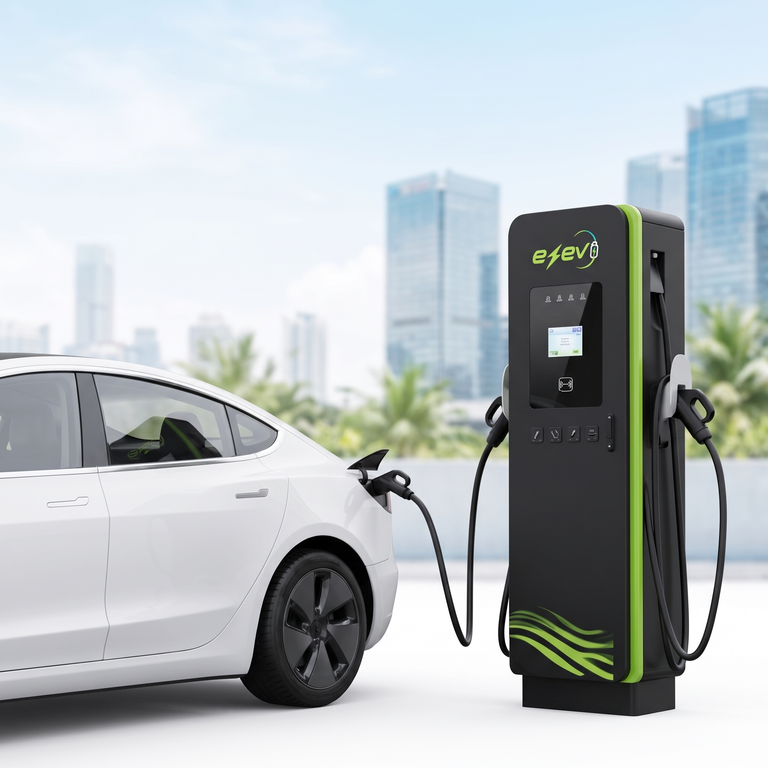
- Easy Plug & Charge focuses on vehicle compatibility and automatic communication between the charger and the vehicle.
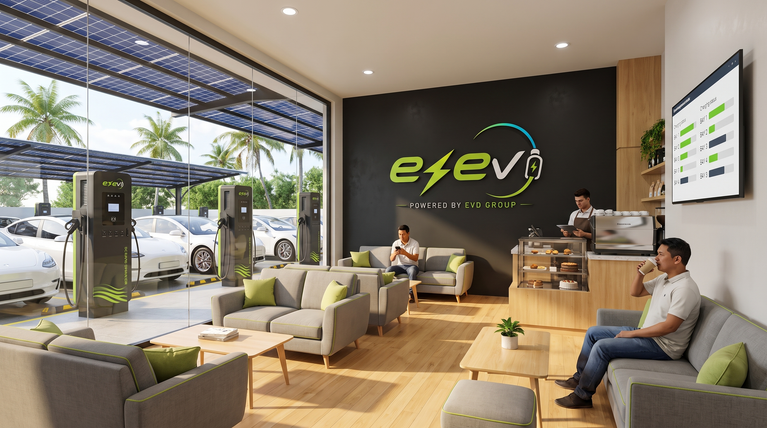
- Easy Access is about placing chargers in practical locations such as shopping centres, public car parks, fuel forecourts and commercial fleet depots.
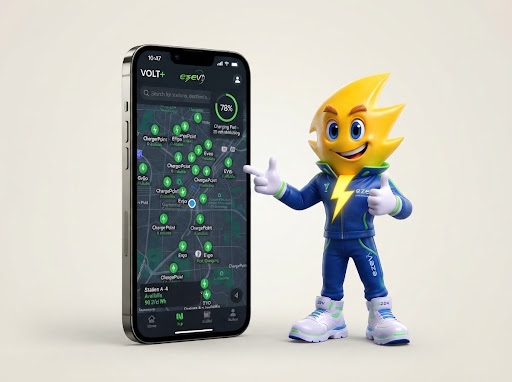
- Easy Payment is intended to support local e-wallets and international cards, reducing unnecessary barriers when a driver arrives at a station.
- Easy Scaling refers to a repeatable station model that can be introduced into other Southeast Asian markets without redesigning the entire system each time.
This is also why EZEV positions itself as brand-neutral. The objective is to build charging infrastructure around driver demand rather than around one particular EV manufacturer.
Backed by EVD Group
EZEV was founded by EVD Group, bringing decades of Vietnamese power-infrastructure experience into the EV charging sector.
Established in 1998, EVD Group developed from the distribution of industrial products into a business covering electrical equipment, automation, renewable energy and battery energy storage. Its energy operations include electrical equipment rated up to 110 kV, alongside solar, wind, biomass and energy-storage projects.
This background matters because a fast-charging network is, at its core, also a power-infrastructure project.
Installing a high-power charger is only one part of the job. A charging location also needs sufficient grid capacity, electrical engineering, civil works, commissioning, monitoring, maintenance and ongoing technical support.
EVD contributes experience in each of these areas. The group has worked with Vietnam Electricity and provincial power companies, operates engineering and technical-support functions, and has an energy-storage centre in Hanoi supporting projects, training and technical work.
Manufacturing Partnership with Juhang Group
The hardware behind the EZEV platform is supported by Hebei Juhang Energy Technology Group, its manufacturing partner in China.
Juhang was founded in 2014 and operates a manufacturing campus covering approximately 70,000 square metres, with more than 300 employees and around USD 35 million in total investment. Its activities cover EV charging equipment, electrical systems, energy storage and related power equipment.
A large part of production is handled in-house, including sheet-metal fabrication, mould manufacturing, SMT and PCB assembly, charger assembly and integrated testing.
That manufacturing capability supports a wide charging range:
- 7–21 kW Smart AC — homes and apartment buildings
- 60–240 kW Mainstream DC — commercial locations and rapid charging
- 300–600 kW Ultra-Fast DC — premium EVs and high-flow sites
- 480–2,500 kW split-type systems — superstations and heavy fleets
Supported charging standards include CCS2, GB/T, CHAdeMO and AC Type 2, while available functions include VIN recognition, IC-card access, QR payment, Ethernet and 4G connectivity.
The same manufacturing platform is already represented in projects outside China, including Vietnam, Thailand, Malaysia and Pakistan.

Connecting Charging with Solar and Battery Storage
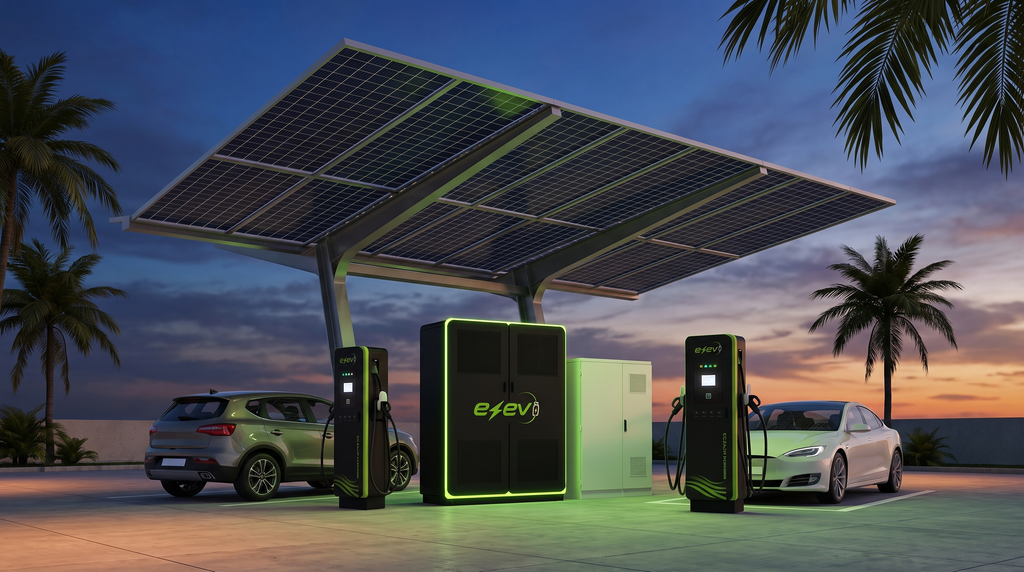
One of the more important parts of the EZEV model is that the company doesn’t treat the charger as an isolated piece of equipment but a part of a wider system that combines EV charging, solar PV, battery energy storage and an Energy Management System.
This becomes particularly useful at high-power charging stations, where the charger itself may be capable of delivering several hundred kilowatts, but the existing grid connection cannot supply that level of power continuously.
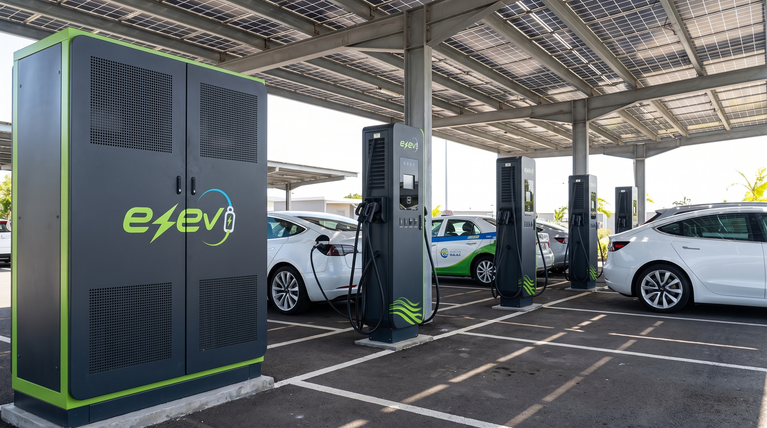
Battery storage can provide additional energy during high-demand charging sessions and recharge more gradually afterward. Solar panels can supply part of the daytime electricity demand, while the EMS coordinates the grid, batteries, solar generation and chargers.
This approach can help sites manage peak loads, reduce pressure on the grid connection and make better use of available energy.
Experience Already in the Field
While the Philippine network represents EZEV’s next major rollout, the companies behind the platform already have an installed project base.
The documented portfolio includes:
- 300+ charging units
- 16 charging station projects
- Charging equipment operating in five countries
- Proven 480 kW station-class systems
- Charging technology extending to 2,500 kW
- A 100 MW / 400 MWh grid-scale battery storage project
- A stated 24-hour on-site technical response commitment through the service network
Charging projects have already been delivered in China, Vietnam, Pakistan, Malaysia and Thailand, covering applications ranging from urban networks and private charging to electric taxi fleets, bus depots and high-power charging hubs.
Building Charging Infrastructure as a Complete System
EZEV’s approach is ultimately about bringing several parts of electric mobility infrastructure together. The company combines charging equipment, power engineering, grid connection, software, payment, solar generation, battery storage, station operations and maintenance within one platform.
Its first major objective is to establish an independent fast-charging network in the Philippines, beginning with Metro Manila. From there, the same operating model is intended to support expansion into other Southeast Asian markets.
For drivers, the goal is straightforward: make EV charging easier to access and easier to use.
For site owners, fleet operators and partners, EZEV offers something broader — a complete charging infrastructure model that can move from site sourcing and electrical design through construction, commissioning, operation and long-term maintenance.
That combination of charging technology, energy infrastructure and operational capability sits behind the company’s central promise: Easy Charging. Easy Life.